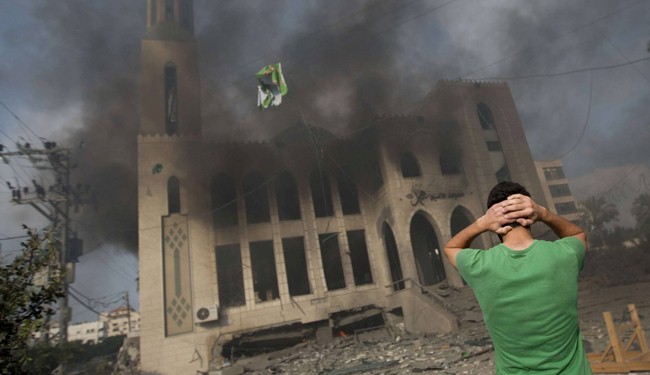
ISRAEL’s new drone technology takes out 40 mosques (aka rocket storage centers) in Gaza in one night
Bare Naked Islam
The Israeli
Air Force bombed 40 mosques in Gaza Tuesday night, July 30, in the most
extensive operation against Hamas’ religious institutions-cum-military
bases so far. In total, at least 50 mosques have been blown up along
with their stockpiles of rockets and arms caches. AWESOME!
 DEBKA
These concentrated air strikes on rocket arsenals are as integral to
Operation Protective Edge as the ground work in destroying tunnels. They
have been stepped up in advance of the preparations launched by the
government on Wednesday for the possible termination of the IDF ground
operation in the Gaza Strip and the withdrawal of troops.
DEBKA
These concentrated air strikes on rocket arsenals are as integral to
Operation Protective Edge as the ground work in destroying tunnels. They
have been stepped up in advance of the preparations launched by the
government on Wednesday for the possible termination of the IDF ground
operation in the Gaza Strip and the withdrawal of troops.
DEBKAfile‘s
sources say that the order to end the ground operation in Gaza would
not mean that the war is over. There are no illusions about the
Palestinian extremist groups laying down their arms. In practical terms,
therefore, Israeli troops will regroup and spread out along the border
as a barrier against future Hamas attempts to keep up its terror
offensive by means of cross-border commando raids using undiscovered
tunnels and firing rockets and mortars into Israel.
 Israel’s war
planners believe the IDF ranged outside the Gaza border is capable of
repelling these assaults by means of tank and artillery fire and air
force drones. The confrontation with Hamas will thus morph into an
ongoing war of attrition.
Israel’s war
planners believe the IDF ranged outside the Gaza border is capable of
repelling these assaults by means of tank and artillery fire and air
force drones. The confrontation with Hamas will thus morph into an
ongoing war of attrition.
This past week
has also seen the first deployment in action of the Air Force’s brand
new Hermes 900 UAV, an unmanned aircraft also known as the Star. Never
before used in wartime operations, the drone’s debut was rushed forward
because of its useful properties: The aircraft can fly nonstop for 30
hours at an altitude of 30,000 feet, the while conducting surveillance,
gathering intelligence and relaying communications to and from military
personnel in the field.
 Star carries
300 kg of attack weaponry. Its cockpit and operating systems are
superior to previous models, enabling commander, operator and crew to
work together seamlessly. It has been functioning almost nonstop in the
Gaza operation with great success.
Star carries
300 kg of attack weaponry. Its cockpit and operating systems are
superior to previous models, enabling commander, operator and crew to
work together seamlessly. It has been functioning almost nonstop in the
Gaza operation with great success.
Manufactured
by Elbit Systems, the drone had until this week only flown test flights
and was not scheduled to become operational until 2015. But Operation
Protective Edge called for an upgraded version of the Air Force’s Hermes
450 – a UAV that flies similar missions — and so the 900 was
fast-tracked into the fleet.
As it is
relatively untested in battle, the Star is only being used for certain
types of missions. When the current war ends, the air force will resume
further study of its performance in emergency situations and diverse
altitudes and weather conditions.


No comments:
Post a Comment