NASA announces latest discoveries from Ultima Thule flyby
NASA
has announced the latest discoveries from the New Horizons spacecraft’s
historic flyby of Ultima Thule in the far reaches of our solar system.
Some
4 billion miles from Earth, New Horizons came within about 2,200 miles
of Ultima Thule when it zoomed past the icy object at 32,000 mph on New
Year’s day. The two fused-together spheres, which extend about 21 miles
in length, are the most distant celestial object ever explored.
In a briefing on Thursday, scientists said that they have not yet found any evidence of an atmosphere on UItima Thule. Initial data analysis has also uncovered no evidence of rings or satellites larger than 1 mile in diameter orbiting Ultima Thule.
NASA SPACECRAFT CAPTURES IMAGES OF ULTIMA THULE IN FARTHEST FLYBY OF SPACE OBJECT IN OUR SOLAR SYSTEM
Ultima Thule is deep within the so-called Kuiper Belt, or Twilight Zone, well beyond the orbit of Neptune. In 2015, New Horizons first visited Pluto, which is barely in the Kuiper Belt, a full 1 billion miles closer to Earth.
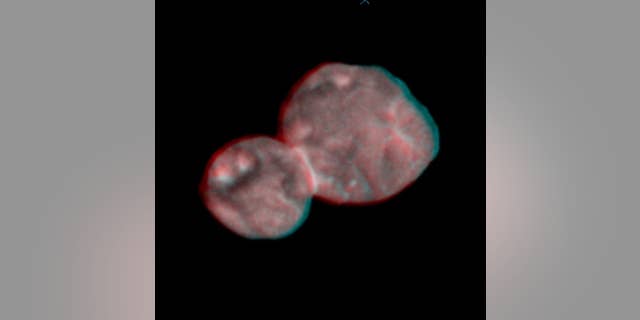
The New Horizons science team created the first stereo image pair
of Ultima Thule. This image can be viewed with stereo glasses to reveal
the Kuiper Belt object's three-dimensional shape. (Credit:
NASA/JHUAPL/SwRI)
On Thursday, scientists reported that the color
of Ultima Thule matches the color of similar worlds in the Kuiper Belt,
as determined by telescopic measurements. A day earlier, New Horizons
yielded its first close-up pictures of Ultima Thule, depicting what NASA said looks like a reddish snowman.
The two “lobes” of Ultima Thule are also nearly identical in color, scientists said Thursday.NASA: ICY OBJECT PAST PLUTO LOOKS LIKE REDDISH SNOWMAN
Since
Tuesday's close approach, New Horizons is already more than 3 million
miles deeper into that mysterious region. It will keep pressing farther
out, observing other objects from afar, and measuring dust and
particles.
The
Johns Hopkins Applied Physics Laboratory in Laurel, Maryland designed
and built New Horizons and is managing the mission for NASA’s Science
Mission Directorate. The Southwest Research Institute is leading the New
Horizons science team and payload operations.
“The first
exploration of a small Kuiper Belt object and the most distant
exploration of any world in history is now history, but almost all of
the data analysis lies in the future,” said Alan Stern of the Southwest
Research Institute, in the statement.
Data
transmission from the spacecraft will pause for about a week as the
spacecraft passes behind the Sun, scientists said Thursday. The
transmission will resume on Jan. 10, starting with a 20-month download
of New Horizons’ remaining “scientific treasures.”

No comments:
Post a Comment