For the people of China, there’s good news and bad news.
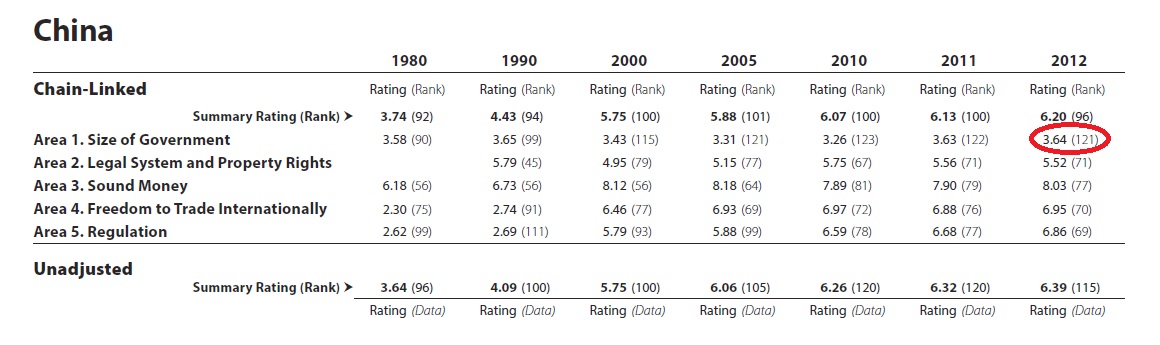
The good news, as illustrated by the chart, is that economic freedom has increased dramatically since 1980. This liberalization has lifted hundreds of millions from abject poverty.
The bad news is that China still has a long way to go if it wants to become a rich, market-oriented nation. Notwithstanding big gains since 1980, it still ranks in the lower-third of nations for economic freedom.
Yes, there’s been impressive growth, but it started from a very low level. As a result, per-capita economic output is still just a fraction of American levels.
So let’s examine what’s needed to boost Chinese prosperity.
If you look at the Fraser Institute’s Economic Freedom of the World, there are five major policy categories. As you can see from this table, China’s weakest category is “size of government.” I’ve circled the most relevant data point.
The bottom line is that China could – and should – boost its overall ranking by improving its size-of-government score. And that means reducing the burden of government spending and lowering tax rates.
With this in mind, I was very interested to see that the International Monetary Fund just published a study entitled, “China: How Can Revenue Reforms Contribute to Inclusive and Sustainable Growth.”
Did this mean the IMF was recommending pro-growth tax reform? After reading the following sentence, I was hopeful