"We're actively looking at the various legal angles that would inform a decision."
That is what an anonymous administration official told the Washington
Post this week about President Barack Obama's deliberations on whether
he will personally involve the United States in another Middle Eastern
war by ordering military action in Syria.
But the only law that ultimately matters here is the one Obama swore
to preserve, protect and defend: the Constitution of the United States.
As recently as six years ago, Obama exhibited a clear understanding
of the power the Constitution does and does not give the president in
using military force.
"The president does not have power under the Constitution to
unilaterally authorize a military attack in a situation that does not
involve stopping an actual or imminent threat to the nation," Obama,
then a presidential candidate, told the Boston Globe in Dec. 20, 2007
interview.
Obama, then, could have been channeling James Madison or George
Washington. He perfectly expressed the original -- and, thus, the
correct -- meaning of the constitutional language on the use of military
force.
Article 1, Section 8 of the Constitution says Congress shall have the
power to "declare war, grant letters of marque and reprisal, and make
rules concerning captures on land and water."
As this column has noted in the past, James Madison's notes from the
Constitutional Convention -- as reported in Max Farrand's "The Records
of the Federal Convention of 1787" -- demonstrate that the Framers
intended this language to deny the president the power to use military
force without prior congressional authorization unless it was necessary
to "repel" an attack.
The draft language discussed in the convention on Aug. 17, 1787, said Congress would have the power "to make war."
Charles Pinckney, a delegate from South Carolina, suggested giving
this power to the Senate alone because, among other reasons, the House
"would be too numerous for such deliberations" and the Senate would be
"more acquainted with foreign affairs."
Pierce Butler, also from South Carolina, proposed "vesting the power
in the President, who will have all the requisite qualities, and will
not make war but when the Nation will support it."
It was then that Elbridge Gerry of Massachusetts and Madison himself
"moved to insert 'declare,' striking out 'make' war; leaving to the
Executive the power to repel sudden attacks."
Roger Sherman of Connecticut said: "The Executive should be able to repel and not to commence war."
"Mr. Gerry," according to Madison's notes, "never expected to hear in
a republic a motion to empower the Executive alone to declare war."
George Mason, reported Madison, was against "giving the power of war
to the Executive, because not safely to be trusted with it; or to the
Senate, because not so constructed as to be entitled to it. He was for
clogging rather than facilitating war; but for facilitating peace. He
preferred 'declare' to 'make.'"
The Framers then voted to give Congress the power "to declare war,
grant letters of marque and reprisal, and make rules concerning captures
on land and water."
George Washington presided over this Constitutional Convention that
decided Congress should retain control over the use of military force
except when it was necessary for the president to "repel sudden
attacks." As longtime Library of Congress scholar Louis Fisher noted in
his definitive book on the issue, "Presidential War Power," Washington
confirmed the original meaning of this power when he dealt with the
Creek Nation.
The Creek Nation, at that time, lived near the border of Georgia and territory claimed by Spain.
On July 24, 1793, Secretary of War Henry Knox and General Andrew
Pickens wrote a memorandum to President Washington (that can now be
found at the National Archives' Founders Online website).
Here Pickens
suggested that Washington raise an army of 5,000 men because Pickens was
"decidedly of opinion that a demonstration of the power of the United
States to punish the Creeks is the only measure which can be adopted to
secure from their cruel depredations the Inhabitants of the South
Western frontiers."
A month later, Washington responded to letter from Gov. William Moultrie of South Carolina asking about the Creeks.
"The Constitution vests the power of declaring war with Congress;"
President Washington wrote the governor, "therefore no offensive
expedition of importance can be undertaken until after they shall have
deliberated upon the subject, and authorized such a measure."
Congress never did authorize offensive action against the Creek Nation, so Washington never took it.
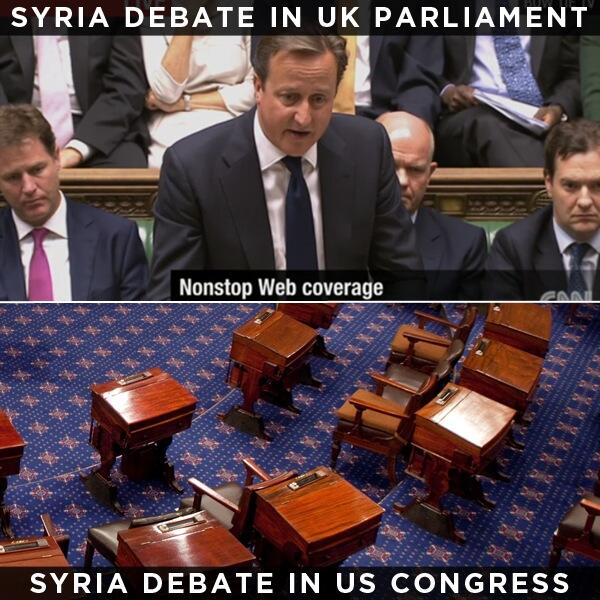
Obama intervened in Libya's civil war without congressional
authorization. Now, he ponders military action in Syria without
congressional authorization. If House Speaker John Boehner meekly stands
by as Obama repeats this usurpation of congressional power, he will
have betrayed his own duty to defend our Constitution.